
The symptom is the starting point, not the final answer.
“Not cooling,” “making noise,” and “heater will not start” are symptoms. They are not complete diagnoses. An AC that runs without cooling could have restricted airflow, a failed blower component, an outdoor-unit electrical problem, a control issue, a refrigerant-circuit problem, or more than one problem at once.
Replacing a part before confirming the cause can waste money and leave the original problem unresolved. A proper diagnosis uses the symptom to decide what to test next.
What a technician may check.
1. Is the system receiving the correct command?
The technician may confirm thermostat settings, operating mode, temperature call, low-voltage signal, and communication between the controls and equipment.
2. Does the equipment have proper power?
A system may appear to have a failed component when the underlying problem is a breaker, disconnect, fuse, transformer, damaged wire, failed safety switch, or control-board issue.
3. Is air moving through the system correctly?
Cooling and heating equipment cannot perform normally without adequate airflow. The assessment may include the filter, blower, indoor coil, return air, supply air, registers, and accessible duct conditions.
4. Which components are operating?
The indoor blower, outdoor fan, compressor, electric heat, heat-pump components, ignition system, and control devices must operate in the correct sequence. The point where that sequence stops often narrows the diagnosis.
5. Is the system producing the expected result?
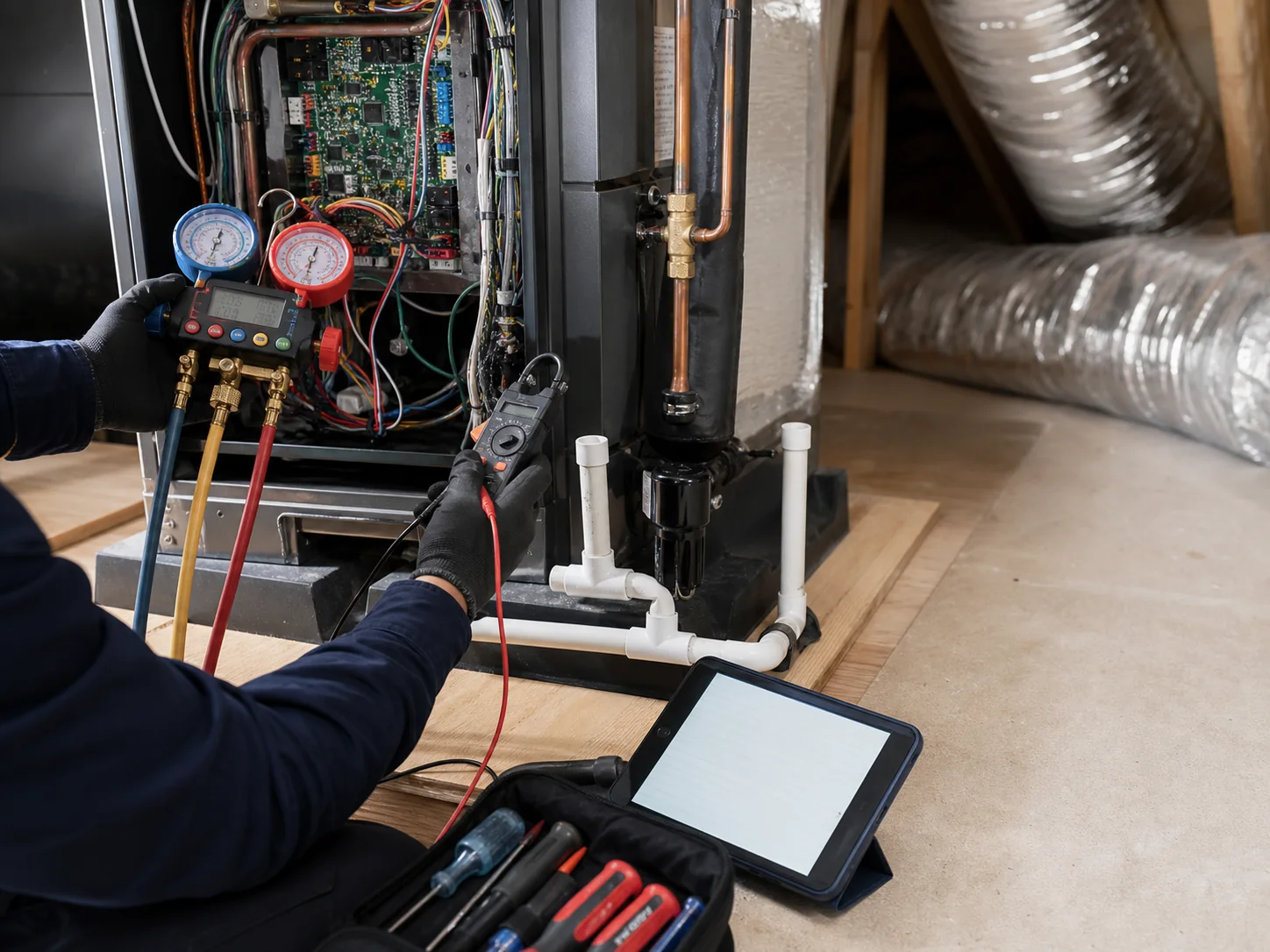
Equipment can run without performing normally. Temperature, airflow, electrical, control, and operating measurements distinguish between “running” and “working correctly.”
What the explanation should sound like.
The thermostat is calling for cooling, and the indoor blower is operating. The outdoor unit has power, but its fan motor is not starting. The motor is receiving the correct command and voltage, which supports the conclusion that the motor has failed.
That explanation provides a chain of evidence: the command is present, power is present, the component is not responding, and the proposed repair matches the finding. A vague statement such as “the outside unit is bad” does not provide the same clarity.
Questions you should be able to ask.
- What test confirmed the failure?
- Is this the only problem you found?
- Is the repair expected to restore normal operation?
- Could another condition cause the new part to fail?
- What is included in the repair price?
- Does the system’s age or condition change the recommendation?
- Is replacement necessary, or simply another option?
Repair versus replacement should be a decision, not a reflex.
Age matters, but age alone does not determine whether a system should be replaced. Repair may make sense when the failure is isolated, the remaining equipment is serviceable, and the repair cost is proportional to expected remaining life.
Replacement deserves consideration when the system has repeated failures, major components are deteriorating, parts are obsolete, comfort is consistently poor, or the current repair is only one part of a larger problem. The right recommendation depends on the complete condition of the equipment and the homeowner’s goals.
Safe checks before calling.
- Confirm the thermostat is set to the intended mode.
- Confirm the temperature setting is calling for heating or cooling.
- Replace a visibly dirty filter with the correct size and type.
- Make sure supply registers and return grilles are not blocked.
- Check whether a breaker has tripped once.
- Note visible water, unusual sounds, smells, or error messages.
Do not repeatedly reset a breaker that trips again. Do not remove equipment panels, bypass safety switches, handle refrigerant, or work inside gas or high-voltage equipment. For gas or carbon-monoxide concerns, leave the affected area and contact the appropriate emergency or utility service.
What happens after the diagnosis.
- The findings are explained.
- The available options are presented.
- The repair scope and price are reviewed.
- You authorize the selected work.
- The approved repair is completed.
- The affected operation is tested again.
- Any remaining concerns are documented.
The Air Valentine standard.
Arthur Lozano has worked in HVAC since 1998. Air Valentine’s repair service is built around a straightforward idea: homeowners should understand the problem before they are asked to make a repair decision.
That means explaining the system in plain language, connecting recommendations to evidence, and presenting practical options without turning every service call into a replacement pitch.