
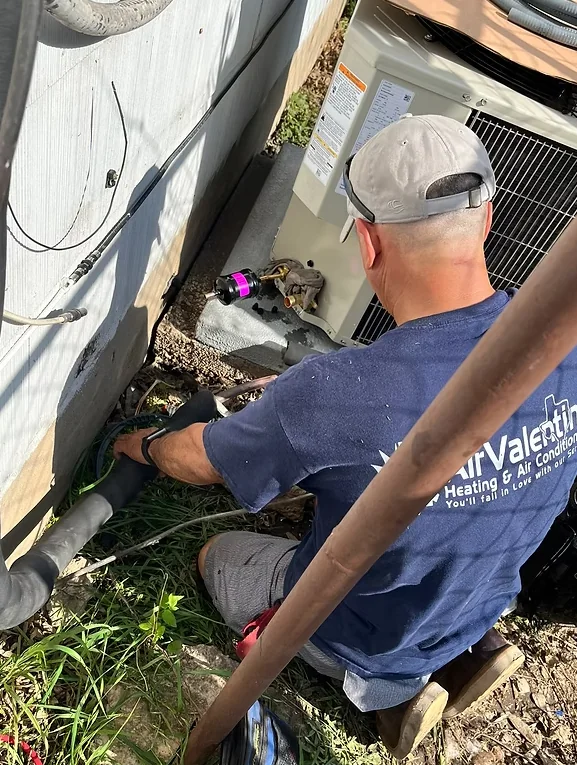
Start with two seasons, not one inflated checklist.
San Antonio equipment spends long hours in cooling mode, but the heating side still needs its own pre-season review. ENERGY STAR recommends annual pre-season checkups—cooling in spring and heating in fall—because the relevant components and safety checks differ.
Air Valentine’s annual maintenance plan follows that practical rhythm: two visits for $150 per system each year, or about $75 per scheduled visit.
A useful baseline checklist
- Thermostat & controls: Confirm the call, sequence, operation, and shutdown.
- Electrical: Inspect accessible connections and evaluate relevant operating readings.
- Airflow: Review filter, blower, supply/return conditions, noise, and temperature performance.
- Drainage: Inspect accessible drain, pan, flow, and safety-switch conditions.
- Cooling: Review outdoor coil, fan, refrigerant-circuit performance, and the cooling cycle.
- Heating: Apply the correct checks for gas heat, electric heat, or a heat pump.
- Report: Separate normal operation, monitoring, maintenance needs, repairs, and safety concerns.
Spring cooling maintenance
The spring visit should confirm that the thermostat calls correctly, the system starts and shuts down normally, accessible electrical components do not show obvious concerns, airflow is reasonable, the outdoor coil can reject heat, and condensate can drain safely. Relevant operating measurements help the technician interpret performance instead of relying on appearance alone.
Fall heating maintenance depends on the equipment.
A gas furnace needs attention to ignition, burners, flame, safety controls, gas and venting conditions that can be observed within the agreed scope. Electric heat requires electrical and heat-strip checks. A heat pump adds outdoor heating operation, mode change, auxiliary heat, and defrost observations. A generic “30-point” claim is less useful than knowing which system was actually tested.
Drain maintenance should describe the actual work.
“Drain check” may mean looking at the line, confirming accessible flow, reviewing the pan and float switch, or clearing an accessible restriction. Rebuilding damaged piping, correcting an improper slope, or opening concealed construction is corrective work—not ordinary tune-up scope.
Refrigerant is not a seasonal consumable.
Refrigerant circulates in a sealed circuit. A technician can evaluate performance indicators during maintenance, but a routine “top-off” should not be treated like changing a filter. When conditions indicate a possible refrigerant problem, the next step is diagnosis; leak searching, repair, evacuation, and refrigerant are separate work.
Ask what “cleaning” means.
Clearing ordinary loose debris from an accessible outdoor coil is different from a deep chemical coil cleaning, removing and washing an indoor coil, pulling and cleaning a blower wheel, or cleaning a duct system. Those services take different access, time, and methods. A proposal should name the surface, method, and boundary.
The condition report is the real deliverable.
Each material finding should fit a clear category: operating normally, monitor, maintenance correction, repair recommended, or safety concern. That structure helps a homeowner distinguish a developing condition from an active fault and a safety issue from a sales preference.
How San Antonio maintenance pricing compares
Public one-time tune-up offers commonly fall around $89–$129, while the broader published range is often about $75–$200 depending on scope. A current local two-visit annual plan lists $212 for one system, and other public memberships commonly advertise around $19–$25 per month. These are not automatically equivalent: some memberships include priority service or discounts, while some do not include two full tune-ups.
Air Valentine’s current site price is intentionally simple: $150 per system each year for one spring visit and one fall visit, plus a 10% repair discount capped at $100.
Homeowner care still matters between visits.
Check the filter monthly during heavy-use seasons and replace it when dirty. Keep the outdoor unit clear of leaves, grass, and stored items. Do not open electrical panels, disturb gas or refrigerant components, or enter unsafe attic spaces to complete a checklist.
What maintenance cannot promise
A tune-up cannot guarantee that a component will not fail later, guarantee a particular energy-bill reduction, or turn an unsafe or inaccessible installation into normal included work. It can provide an informed view of current operation and a clearer basis for the next decision.